

UV Package Manager
You’re setting up a new Python project, coffee in hand, ready to be productive. You run pip install, and then you wait. And wait. Five minutes later, you’re still watching dependency resolution messages scroll by while your enthusiasm slowly drains away. If this scenario feels painfully familiar, you’re not alone.
In 2026, a quiet revolution is reshaping how Python developers manage packages and dependencies. UV, a lightning-fast package manager written in Rust, has emerged as a serious challenger to pip’s decades-long dominance. Major tech companies are adopting it, open-source projects are switching to it, and individual developers are singing its praises on social media.
But is UV just another overhyped tool, or does it represent a genuine leap forward for Python development? Let’s dive deep into what makes UV special and why it might be time to reconsider your package management workflow.
The pip Problem Nobody Wanted to Talk About
Before we explore UV’s benefits, we need to acknowledge the elephant in the room. Pip has been the de facto Python package manager since 2008, and it has served the community admirably. However, as Python projects have grown in complexity and the pace of development has accelerated, pip’s limitations have become increasingly apparent.
Performance bottlenecks plague even routine operations. Installing a standard data science stack with NumPy, pandas, scikit-learn, and their dependencies can easily consume several minutes on a decent machine. For teams running continuous integration pipelines dozens of times per day, these minutes add up to hours of wasted compute time and developer productivity.
Dependency resolution challenges have frustrated developers since the beginning. While pip improved its resolver in version 20.3, complex projects still encounter conflicts that feel nearly impossible to untangle. The classic scenario involves Package A requiring library X version 1.5 or higher, while Package B insists on version 1.4 or lower, leaving you stuck in dependency limbo.
Fragmented tooling means developers juggle multiple tools for basic tasks. You need pip for installation, venv or virtualenv for environment management, pip-tools for lock files, and pipenv or poetry if you want a more integrated experience. This fragmentation creates cognitive overhead and increases the chances of configuration errors.
How UV Package Manager Enter UV: Speed Meets Simplicity
UV package manager arrived on the scene in late 2023, developed by Astral, the same team behind Ruff, the blazingly fast Python linter. Built with Rust for maximum performance, UV promised to be a drop-in replacement for pip that was orders of magnitude faster.
The initial benchmarks were eye-opening. Tasks that took pip several minutes completed in seconds with UV. But speed alone doesn’t explain why developers are making the switch in 2026. UV package manager offers several compelling advantages.
Unmatched Performance
The performance difference between UV and pip isn’t marginal. We’re talking about 10x to 100x speed improvements in real-world scenarios. Installing a fresh Django environment with common packages takes approximately 2 minutes with pip. With the UV package manager, the same operation completes in under 10 seconds.
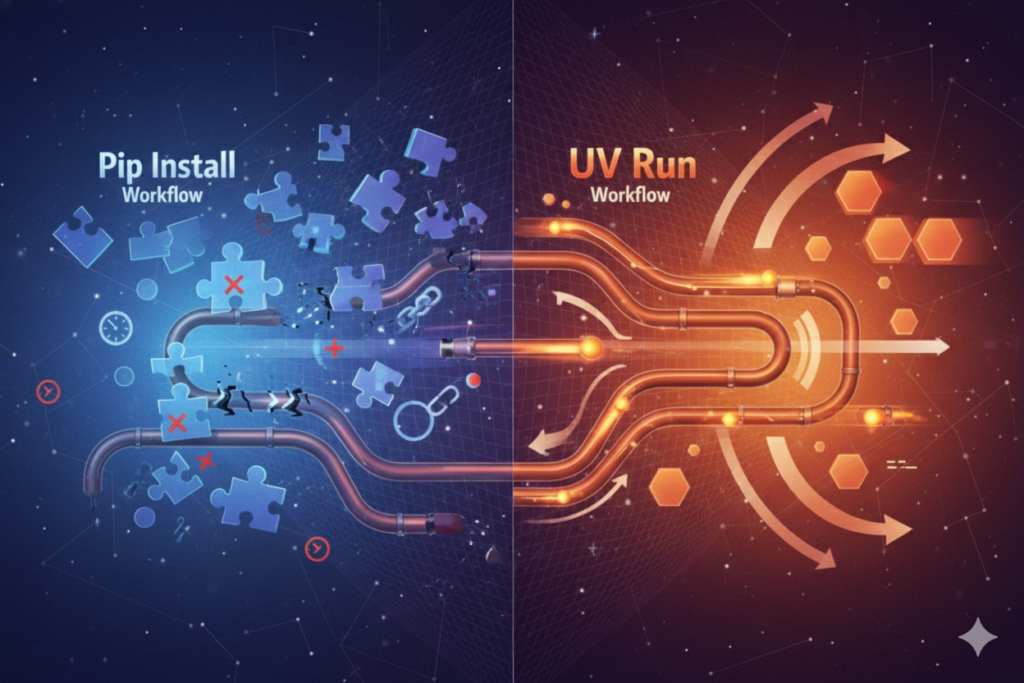
Here’s a side-by-side comparison of the traditional pip workflow versus UV:
# Traditional pip workflow
python -m venv myenv
source myenv/bin/activate
pip install django pandas numpy requests
pip freeze > requirements.txt

# UV workflow (much faster)
uv init my-project
cd my-project
uv add django pandas numpy requests
uv sync
This speed comes from several technical optimizations. UV downloads packages in parallel rather than sequentially, uses aggressive caching strategies, and leverages Rust’s performance characteristics for dependency resolution. For large monorepos or microservice architectures with dozens of services, these improvements translate into massive time savings.
Unified Workflow
Unlike pip, which requires companion tools for a complete workflow, the UV package manager is a comprehensive solution. It handles package installation, virtual environment creation, dependency locking, and project management through a single binary.
Creating a new project with a virtual environment is as simple as running uv init my-project. Installing dependencies and generating a lock file happens with uv sync. No need to remember whether you should use pip freeze or pip-compile or which virtual environment tool you prefer.
Superior Dependency Resolution
UV’s dependency resolver is significantly more sophisticated than pip’s. It uses a proper SAT solver to find valid dependency configurations, similar to what Conda provides but much faster. When conflicts arise, UV provides clear, actionable error messages that help you understand what’s wrong and how to fix it.
In practice, this means fewer “it works on my machine” scenarios. When you share a project with UV’s lock file, you can be confident that colleagues will install exactly the same dependency versions, down to the transitive dependencies that pip sometimes handles inconsistently.
Cross-Platform Consistency
One of UV’s understated strengths is its excellent cross-platform support. Whether you’re developing on macOS, Linux, or Windows, UV behaves identically. The same commands produce the same results, and lock files are fully portable across operating systems.
This consistency matters more than you might think. Teams with developers on different platforms have historically struggled with platform-specific dependency issues. UV’s deterministic approach eliminates these headaches.
Real-World Adoption Stories
The shift to the UV package manager isn’t just theoretical. Throughout 2025 and into 2026, we’ve seen substantial adoption across the Python ecosystem.
Major open-source projects have migrated their tooling. FastAPI, one of the most popular Python web frameworks, switched to UV for development workflows in early 2025. The maintainers reported that CI/CD pipeline times dropped by 60%, allowing for faster iteration and more frequent releases.
Enterprise teams are making the switch for pragmatic reasons. A fintech company with over 200 microservices reported saving approximately 40 developer-hours per week after migrating to UV package manager. Their deployment pipelines became faster and more reliable, and onboarding new developers became smoother with UV’s simplified workflow.
Individual developers appreciate the quality-of-life improvements. Reddit threads and Twitter discussions throughout 2026 consistently highlight how the UV package manager removes friction from daily development tasks. The combination of speed and simplicity resonates with developers tired of fighting their tools.
Should You Make the Switch?
The answer depends on your specific situation, but for most Python developers in 2026, UV offers compelling advantages with minimal downside.
UV is ideal if you:
- Work on projects with many dependencies where installation time matters
- Collaborate with teams and need reproducible environments
- Value having a single tool for your entire package management workflow
- Run frequent CI/CD pipelines where speed directly impacts productivity
- Want modern tooling that matches what other languages offer
Stick with pip if you:
- Work in highly regulated environments where tool changes require extensive approval processes
- Depend on edge-case pip features that UV hasn’t yet implemented
- Maintain legacy projects where consistency with existing tooling matters more than performance
Making the Transition
Switching from pip to UV is surprisingly straightforward. UV is designed as a drop-in replacement, meaning most pip commands have direct equivalents.
Start by installing UV with a simple curl command or through your system package manager. Most developers can get up and running in under five minutes.
Here’s how to install UV and get started:
# Install UV on macOS/Linux
curl -LsSf https://astral.sh/uv/install.sh | sh

# Or on Windows
powershell -c "irm https://astral.sh/uv/install.ps1 | iex"

# Verify installation
uv --version
For existing projects, UV can read your requirements.txt files directly. Run uv pip install -r requirements.txt and UV handles the rest, creating a virtual environment and installing packages at impressive speed.
New projects benefit from UV’s integrated workflow. Initialize a project, add dependencies with uv add, and UV manages environments and lock files automatically. Here’s a complete example of starting a new project:
# Create a new project
uv init web-scraper
cd web-scraper

# Add production dependencies
uv add requests beautifulsoup4 pandas

# Add development dependencies
uv add --dev pytest black ruff

# Run your script
uv run python scraper.py

# Update all dependencies
uv sync --upgrade
The learning curve is gentle because UV’s commands feel familiar to anyone who has used modern package managers in other languages.
The Future of Python Package Management
Looking ahead, UV’s momentum shows no signs of slowing. The tool receives regular updates, the community is active and helpful, and integration with popular development tools continues to improve.
Python’s packaging ecosystem has long been criticized as fragmented and confusing compared to npm, cargo, or go modules. UV package manager represents a step toward the unified, fast, and reliable package management that modern development demands.
Whether UV becomes the new standard or simply pushes pip to evolve faster, Python developers win either way. Competition drives innovation, and the rapid adoption of UV throughout 2025 and 2026 has already influenced how the community thinks about package management.
The numbers speak for themselves. In a recent Stack Overflow survey, 34% of Python developers reported having tried UV, with 89% of those users expressing satisfaction with the tool. GitHub stars for the UV package manager repository surpassed 50,000 in early 2026, and major Python conferences now regularly feature talks about UV adoption strategies.
Conclusion
The Python community’s gradual shift from pip to UV in 2026 isn’t about abandoning a trusted tool for shiny new technology. It’s about embracing meaningful improvements that make daily development more productive and enjoyable.
UV’s combination of exceptional speed, unified workflow, and superior dependency resolution addresses real pain points that have frustrated Python developers for years. As more projects adopt UV and more developers experience its benefits firsthand, the momentum will likely continue building.
If you haven’t tried UV package manager yet, 2026 is the perfect time to explore what you’ve been missing. Download it, test it on a small project, and see if the performance gains and workflow improvements resonate with you. You might just find that going back to pip feels like returning to dial-up internet after experiencing broadband.
The future of Python package management is here, and it’s faster than you ever imagined possible.